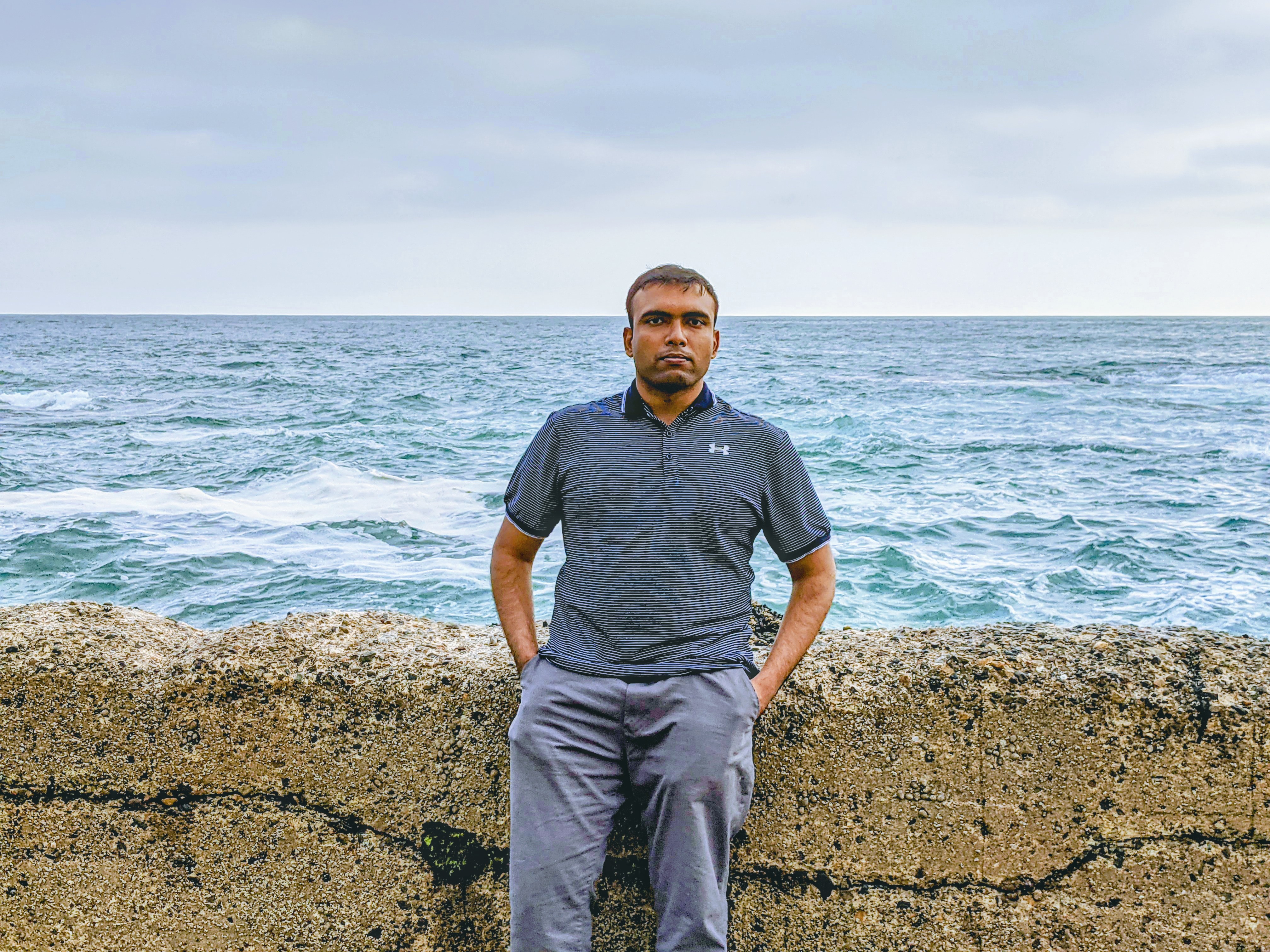
About Me
I am a Ph.D. candidate specializing in machine learning, deep learning, and computer vision, with a strong focus on biomedical image analysis. My research develops data-efficient and reliable medical AI through domain adaptation, vision–language models, and active learning—enabling systems that adapt to domain shifts and significantly reduce annotation burdens, particularly for segmentation tasks. I also build segmentation, tracking, and visualization pipelines for high-dimensional microscopy data, and have experience with GANs, GNNs, transformers, multimodal fusion, federated learning, human pose estimation, and spatio-temporal tracking.
Education
- Ph.D., University of California Riverside (2020–Present)
Electrical & Computer Engineering
UCR Vision and Learning Group
Advisor: Amit K. Roy-Chowdhury - M.Sc., Bangladesh University of Engineering and Technology (2017–2020)
Electrical & Electronic Engineering
Advisor: S.M. Mahbubur Rahman - B.Sc., Bangladesh University of Engineering and Technology (2013–2017)
Electrical & Electronic Engineering
Advisor: Mohammad Ariful Haque
Selected Research Projects
Online Domain Adaptive Medical Image Segmentation (ODES)
A source-free, single-pass online domain adaptation framework designed for medical image segmentation under severe domain shift.
Integrates expert-guided active learning, noisy pseudo-label pruning, and diversity-aware sample selection to minimize annotation cost
while outperforming modern test-time adaptation baselines.
paper -
code
Active Learning via Vision–Language Models (LINGUAL)
A language-guided annotation strategy that replaces pixel-level corrections with natural-language instructions.
These instructions are translated into executable segmentation refinement programs through large language models, reducing annotation time by ~80%
while maintaining or surpassing state-of-the-art active learning baselines.
pre-print
Bio-Image Analysis (3D + Time)
- 3D segmentation, reconstruction, and registration of volumetric plant cell datasets acquired via CLSM microscopy.
- Designing a deep spatio-temporal tracking system using Graph Neural Networks (GNNs) for cell lineage reconstruction and division detection.
- 3D segmentation and morphological analysis of Drosophila wing disc imagery for developmental biology applications.
Agentic Medical Report Generation (Ongoing)
Building an agentic report-generation system for chest X-rays that performs stepwise, uncertainty-aware reasoning grounded directly in visual evidence. The pipeline distinguishes ambiguous findings from confident impressions and dynamically adapts its reasoning trajectory to generate more reliable clinical reports.
Gait Phase Analysis
Developed a novel sEMG-driven gait phase classification algorithm for DNS, UPS, and WAK locomotion modes, targeting robust real-time locomotion analysis.
paper
Music-to-Dance Synthesis (CNN–LSTM–MDN + GAN)
A multimodal generative framework that learns music-conditioned human motion using a CNN–LSTM–MDN architecture for rhythmic pose generation
and a Pix2pixHD GAN for high-fidelity dance synthesis. Demonstrated superior style retention across Ballet, Rumba, Cha-Cha, Tango, and Waltz.
paper —
video
BRIAR
Developed modules for multi-person tracking under occlusion, silhouette segmentation, and GAIT/ReID-based identity recognition within the BRIAR dataset pipeline.
Asynchronous Federated Learning
Designed a delay-aware asynchronous FL framework addressing client stragglers via buffer diversification and contribution-weighted aggregation, improving convergence stability under heterogeneous system conditions.
Selected Publications
-
Md Shazid Islam, Sayak Nag, Arindam Dutta, Miraj Ahmed, Fahim Faisal Niloy, Shreyangshu Bera, Amit K. Roy Chowdhury,
“ODES: Online Domain Adaptation with Expert Guidance for Medical Image Segmentation”
MICCAI 2025 — paper code -
Md Shazid Islam, Arindam Dutta, Calvin-Khang Ta, Kevin Rodriguez, Christian Michael, Mark Alber, G. Venugopala Reddy, Amit K. Roy Chowdhury,
“DEGAST3D: Learning Deformable 3D Graph Similarity to Track Plant Cells in Unregistered Time Lapse Images”
IEEE T-CBB, 2025 — paper code -
Md Shazid Islam, Shreyangshu Bera, Sudipta Paul, Amit K. Roy Chowdhury,
“LINGUAL: Language-INtegrated GUidance in Active Learning for Medical Image Segmentation”
Under Review — pre-print -
Md Shazid Islam, SM Mahbubur Rahman,
“Synthesis of Dance by Learning Body Gestures from Music”
Multimedia Tools & Applications, 2025 — paper — video -
Md Shazid Islam, M Yashwanth, Xiangyu Chang, Anirban Chakraborty, Srikanth Krishnamurthy, Amit Roy-Chowdhury,
“DAAFL: Delay Aware Asynchronous Federated Learning”
Under Review -
Md Sanzid Bin Hossain, Md Shazid Islam, Md Saad Ul Haque, Md Saydur Rahman,
“Gait Phase Classification from sEMG in Multiple Locomotion Mode Using Deep Learning”
9th International Congress on ICT, London, 2024 — paper -
Md Shazid Islam, ASM Jahid Hasan, Md Saydur Rahman, Jubair Yusuf, Md Saiful Islam Sajal, Farhana Akter Tumpa,
“Location Agnostic Source-Free Domain Adaptive Learning to Predict Solar Power Generation”
IEEE Energy Technologies for Future Grids, Wollongong, 2023 — paper -
Md Saiful Islam Sajol, ASM Jahid Hasan, Md Shazid Islam, Md Saydur Rahman,
“A ConvNeXt V2 Approach to Document Image Analysis: Enhancing High-Accuracy Classification”
IEEE Conference on Information Technology and Data Science, Debrecen, 2024 — paper -
Md Saiful Islam Sajol, ASM Jahid Hasan, Md Shazid Islam, Md Saydur Rahman,
“Transforming Social Media Analysis: TweetEval Benchmarking with Advanced Transformer Models”
ISMSIT, Ankara, 2024 — paper